

How Much Floor Load Does a Spider Crane Create? A Guide for Indoor and Rooftop Lifts
Short answer: a Risenmega spider crane weighs from 1,200 kg to 15,500 kg. On its rubber tracks it exerts roughly 35–57 kPa, but once the outriggers are down, a single leg on a 3-ton unit can push about 42 kN into the floor. That is many times what an ordinary office floor is designed to carry at one point, so the model, pads and a structural check all matter.
View Spider Cranes Request a Load Check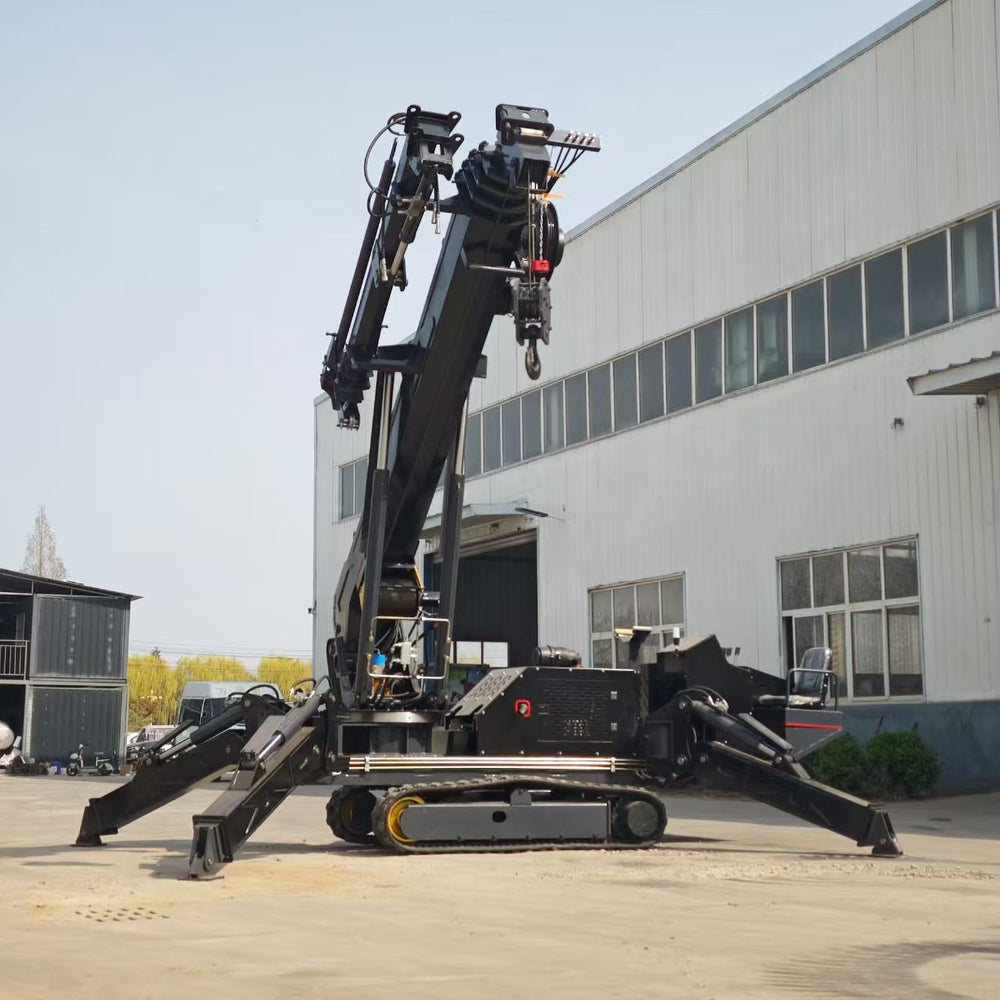
The Quick Answer: Floor Load Is Three Different Numbers
Buyers often ask for one "floor load" figure. In practice a spider crane creates three, and each one is checked against a different part of the building.
Machine weight
The dead load of the crane itself, from 1,200 kg (RM1.0) to 15,500 kg (RM16.0). It decides whether the crane can be moved in and which floors it can cross.
Track pressure
The average pressure of the rubber crawler tracks while driving or parked. Modest for its size, but still far above a floor's distributed rating.
Outrigger point load
The concentrated force under each leg during a lift. This is usually the number that governs indoor and rooftop work.
Spider Crane Weight and Track Ground Pressure by Model
The table below uses the published specifications from our 1–16 ton spider crane page. Average track pressure is machine weight divided by the contact area of both tracks (track length × width × 2).
| Model | Capacity | Machine weight | Folded L×W×H (mm) | Track (mm) | Avg. track pressure |
|---|---|---|---|---|---|
| RM1.0 | 1 ton | 1,200 kg | 2260 × 600 × 1470 | 1110 × 150 | ≈ 35 kPa |
| RM2.0 | 2 ton | 1,550 kg | 2450 × 750 × 1470 | 1110 × 150 | ≈ 46 kPa |
| RM3.0 | 3 ton | 2,700 kg | 3550 × 955 × 1700 | 1600 × 230 | ≈ 36 kPa |
| RM5.0 | 5 ton | 6,800 kg | 4650 × 1400 × 2160 | 2200 × 300 | ≈ 51 kPa |
| RM8.0 | 8 ton | 7,800 kg | 5010 × 1600 × 2200 | 2570 × 350 | ≈ 43 kPa |
| RM10.0 | 10 ton | 9,300 kg | 5550 × 1850 × 2300 | 2570 × 350 | ≈ 51 kPa |
| RM12.0 | 12 ton | 11,500 kg | 6050 × 1850 × 2300 | 2570 × 400 | ≈ 55 kPa |
| RM14.0 | 14 ton | 14,500 kg | 6300 × 2000 × 2400 | 3350 × 400 | ≈ 53 kPa |
| RM16.0 | 16 ton | 15,500 kg | 6800 × 2000 × 2400 | 3350 × 400 | ≈ 57 kPa |
Do not compare these kPa figures directly with a floor rating. An office floor is typically designed for about 2.4 kPa spread evenly, so a crawler's 35–57 kPa looks 15–24 times too high. But floors are also checked for concentrated loads, and the real question is how the slab resists a heavy load on a small footprint. Figures assume full track contact and are static, machine-only values.
Outrigger Load: The Number That Really Matters
When the four independent outriggers deploy and the crane lifts, the machine, the load and the rigging all transfer through those legs. The leg under the boom carries the most, and it lands on a small pad.
The examples below are a screening estimate: total working weight (machine plus rated load at short radius), with up to 75% assumed on the single worst leg. Actual reactions depend on boom angle, slew position and attachment, so ask us for model-specific data before you finalize a plan.

The 3-ton RM3.0 folds to 955 mm wide and weighs 2,700 kg.
| Model | Machine + rated load | Total weight | Est. peak outrigger load | On a 0.5 × 0.5 m pad | On a 1 × 1 m spreader* |
|---|---|---|---|---|---|
| RM1.0 | 1,200 + 1,000 kg | 21.6 kN | ≈ 16 kN | ≈ 65 kPa | ≈ 16 kPa |
| RM2.0 | 1,550 + 2,000 kg | 34.8 kN | ≈ 26 kN | ≈ 104 kPa | ≈ 26 kPa |
| RM3.0 | 2,700 + 3,000 kg | 55.9 kN | ≈ 42 kN | ≈ 168 kPa | ≈ 42 kPa |
| RM5.0 | 6,800 + 5,000 kg | 115.8 kN | ≈ 87 kN | ≈ 347 kPa | ≈ 87 kPa |
*Nominal pressure assuming the spreader distributes load evenly. It does not replace a slab punching-shear or bending check. Pad sizes are examples; custom aluminum outrigger pads are available on request.
What Are Floors Actually Designed For?
Building codes set minimum design loads, and your building may have more (or less) reserve. Typical U.S. ASCE 7 minimums show why a crane leg needs review:
| Area type | Uniform load | Concentrated load |
|---|---|---|
| Offices | 50 psf (2.4 kPa) | 2,000 lb (8.9 kN) |
| Light manufacturing / light storage | 125 psf (6.0 kPa) | 2,000 lb (8.9 kN) |
| Passenger parking garages | 40 psf (1.9 kPa) | 3,000 lb (13.4 kN) on a small area |
| Ordinary roofs (not for occupancy) | 20 psf (0.96 kPa) | Varies by member and use |
Reality check: the estimated 16 kN under an RM1.0 leg is already about twice the 8.9 kN office concentrated minimum, and an RM3.0 leg at 42 kN is nearly five times higher. That does not mean the lift is impossible. It means spreader mats and an engineer's sign-off belong in the plan. Codes outside the U.S., including Eurocode-based ones, use their own categories, so always work from your local rules and the building's structural drawings.
Indoor Spider Crane Lifts: Six Floor Checks
Spider cranes exist for tight access: the RM1.0 folds to 600 mm and the RM3.0 to 955 mm, so both pass through standard doorways. The battery-electric option on RM1.0–RM3.0 is zero-emission and near-silent, which suits occupied buildings. Before you roll one in, check these:
1. Slab type
A ground-bearing slab on compacted fill behaves very differently from a suspended slab over a basement or parking level.
2. What is beneath
Voids, ducts, drains, and services under the slab can fail under a point load even when the slab looks sound.
3. Post-tensioned floors
Never drill or anchor without locating tendons. Use pads only and ask the engineer.
4. Spread the load
Use plywood, steel or aluminum mats under every outrigger. Level and support them fully, with no bridging over gaps.
5. Travel route
Plan the path from the entrance to the lift point, avoiding edges, hatches, trenches and lightly loaded zones.
6. Load path below
On upper floors, check the beams, columns and floors below, not only the slab you stand on.
Glass and façade crews can add a vacuum head to the same machine, see our RM-SC suction cup lifters and spider crane attachments. Remember that every attachment adds weight to the outrigger calculation.
Rooftop Lifts: Two Very Different Scenarios
A. Crane on the ground
The common case. The crane stays at ground level and places HVAC units, glass or steel on the roof. The roof only needs to take the landing and stacking load, so check the spot where materials will rest. Choose a model whose reach covers the height: RM5.0 reaches 16 m and RM8.0 18.2 m.
B. Crane on the roof
Rare and higher risk. Ordinary roofs are often designed for only about 20 psf, and outrigger loads are concentrated. This needs a written structural assessment, and often shoring or a podium slab. Small models such as RM1.0 and RM2.0 are the usual candidates.

The 5-ton RM5.0 weighs 6,800 kg and reaches 16 m.
How to Check Floor Load Before You Lift: 5 Steps
Gather the drawings
Get slab type, thickness, span and design live loads from the owner or engineer.
Define the real lift
Note the heaviest load, the radius, the attachment and the exact position of the crane.
Design the pads
Size spreaders so pressure and punching shear stay within what the engineer approves.
Lock the plan
Stay inside the load chart, keep the route clear and use the wireless remote (100 m range) from a safe spot.
Which Risenmega Spider Crane Suits Your Floor?
Light indoor: RM1.0 and RM2.0
Lowest weight (1,200 and 1,550 kg), narrowest folded width and the lowest outrigger loads. See the 1 ton and 2 ton models.
Renovation and glazing: RM3.0
10 m lift height in a 955 mm-wide body. The most popular balance of reach and access. See the 3 ton model.
Rooftops and mezzanines: RM5.0+
16 m and beyond, best used from firm ground or engineered surfaces. See the 5 ton model or the full 1–16 ton range, from $10,428.
Want the story from real jobs? Read our European spider crane customer cases and our complete spider crane guide.
Frequently Asked Questions
How much does a spider crane weigh?
Risenmega models weigh 1,200 kg (RM1.0) to 15,500 kg (RM16.0). A 3-ton unit is 2,700 kg and a 5-ton unit 6,800 kg.
Can a spider crane be used on a concrete floor inside a building?
Yes, if the slab is checked for concentrated outrigger loads. Use spreader mats, confirm what lies beneath the slab, and get the lift plan approved by a structural engineer.
Can a spider crane work on a roof?
Usually the crane stays on the ground and places materials on the roof. Standing the crane on a roof needs a written structural assessment.
Do spider cranes damage floors?
Rubber tracks are gentle on finished surfaces, but outrigger legs concentrate load. Pads or mats spread it and protect finishes.
Where can I get outrigger load data for my model?
Send us your model, load, radius and attachment. We will supply reference outrigger reaction data for your engineer.
Planning an Indoor or Rooftop Lift?
Tell us the load weight, lift height, access width and floor type. Our team will recommend a model and send the outrigger data your engineer needs. Every unit is CE certified and ships from Qingdao (FOB, CIF or DDP).
Chat on WhatsApp Get a Free Quote


