

Scissor Lift Table Buying Guide: How to Choose the Right Capacity, Height and Platform
A lift table that is too small, too tall when lowered or under-rated costs you every shift. Use this guide to match load, platform, lifting height, power and safety options to your real workflow — before you request a quote.

Choose a lift table with five checks
To pick the right scissor lift table, confirm these five things, in this order. If any one is wrong, the table will not fit your job.
- Load: heaviest load plus pallet and fixtures, with 20-25% margin.
- Platform: at least the full footprint of the load, including overhang.
- Heights: lowered height low enough to load; maximum height high enough to reach.
- Mobility and shape: fixed, wheeled, rotating, roller or U-shape.
- Power and safety: voltage, lifting time, braking, emergency descent and stop.
For Risenmega’s standard RMSSL series, that means 1,000, 2,000 and 4,000 kg classes, lowered heights of 205–350 mm, maximum heights of 1,000–1,400 mm and platforms from 1,300 × 820 mm up to 2,200 × 1,800 mm.
Jump to:
Which type of lift table do you actually need?
A lift table is a platform on a hydraulic scissor mechanism that raises loads to a comfortable working height. Risenmega groups its range into five families. Pick the family first, then size it.
| Family | Best for | Watch out for | Browse |
|---|---|---|---|
| Standard | Production lines, workshops, general pallet lifting at a fixed station | Lowered height of 205–350 mm needs a ramp or pit for pallet trucks | Standard lift tables |
| Heavy duty | Dense loads, 2–5 t, frequent cycles, die and mould handling | Heavier unit and larger motor; check floor strength | Heavy duty lift tables |
| Movable | Several stations sharing one table; maintenance and flexible layouts | Brake the wheels before lifting; confirm power supply at each station | Movable lift tables |
| Low height | Loading straight from the floor with pallet trucks or hand carts | A lower collapsed height can mean a shorter stroke — check maximum height | Low height lift tables |
| Other shapes | Rotary turntable, roller, U-shape and special platforms for special loads | Custom drawings and lead time; confirm load position early | Other shape lift tables |
Need to lift people or work at height instead of positioning loads? That is a different machine — see our scissor lift (aerial work platform) range. For moving goods between floors, read Cargo Lift vs. Freight Elevator.
How to choose a lift table in 7 steps
Work through the steps in order and write each number down. By step 7 you will have a spec sheet you can send for a quotation.
Set the capacity
Weigh the heaviest load you will ever place on the table, then add the pallet, container and any fixtures.
- Add a margin of at least 20–25% for off-centre loads and shocks (a practical rule of thumb).
- Risenmega lists 300, 500, 1,000, 1,500, 2,000, 2,500, 3,000, 3,500 and 4,000 kg variants.
Size the platform
The platform must carry the full footprint of the load, including overhang. Bigger platforms are also heavier.
- For a 1,200 × 1,000 mm pallet, a 1,700 × 1,000 mm platform (RMSSL1004) fits with room to spare.
- Check the frame size as well. On RMSSL1004 the frame is 1,580 × 640 mm under a 1,700 × 1,000 mm platform.
- Weight rises with size: from 200 kg (RMSSL1003) to 430 kg (RMSSL1008) in the 1,000 kg class.
Match the heights
Three numbers matter: lowered height, maximum height and the stroke between them.
- Stroke = maximum height − lowered height. RMSSL1003: 1,300 − 240 = 1,060 mm.
- Lowered height must suit how you load. Many hand pallet trucks lower their forks to roughly 85 mm, so a 205–350 mm platform needs a short ramp or a floor pit.
- Maximum height must reach your conveyor, truck bed or workbench with a few centimetres to spare.
Decide on mobility and shape
A fixed table is the lowest-cost option. Choose a different shape only when the job needs it.
- Movable: manual or electric versions on heavy-duty casters.
- Rotary: turntable top to rotate the load.
- Roller: roller platform for pushing loads on or feeding a conveyor.
- U-shape: platform that straddles a pallet or skid.
Confirm power and speed
Tell us your local voltage and phase — Risenmega tables are built to a customizable voltage.
- Reference motors: 1.1 kW (1,000 kg class), 1.5–2.2 kW (2,000 kg), 2.2 kW (4,000 kg).
- Reference lifting time runs from about 20 to 40 seconds for a full stroke.
- Higher stroke or heavier load means a longer rise, so plan your cycle time.
Specify safety features
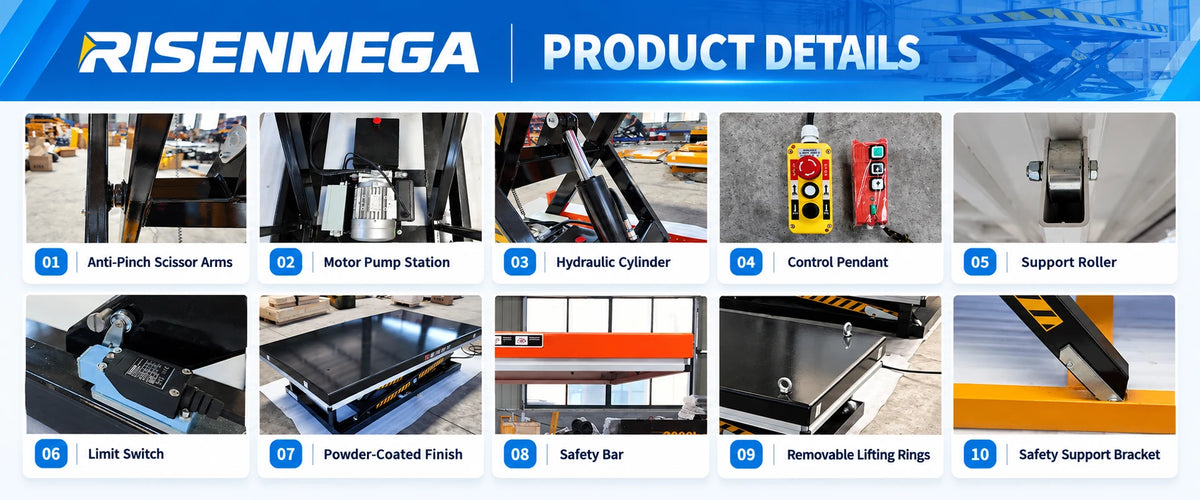
Look for anti-pinch scissor arms, a limit switch, a safety bar and a safety support bracket for maintenance. Then add the options you need:
- Automatic braking system
- Emergency descent system
- Emergency stop button
- Explosion-proof line protection (hose-burst safeguard)
Buyers in Europe should ask for CE documentation and the lifting-table safety standard EN 1570-1. In the US, OSHA’s material-handling clearance rules (1910.176) also apply to the space around the table.
Check the environment and duty cycle
Where will the table work, and how hard? Dust, chips, spatter and washdown call for a bellows cover; platform edges call for guardrails. Risenmega states its hydraulic scissor tables are designed to lift over one million times, so duty cycle is a design input, not an afterthought — tell us your cycles per shift and we will check the cylinder and motor.
Example: lifting 800 kg pallets to a 1,200 mm truck bed
A distribution team loads 1,200 × 1,000 mm pallets of up to 800 kg onto a truck bed at 1,200 mm. Here is how the checks turn into a model.
Your numbers will differ — the method does not. Send us your load, pallet size and target height, and we will check the match.
6 common lift table buying mistakes
Buying to the exact load
Sizing capacity to the nominal load leaves no room for off-centre weight, pallets and shock. Add 20–25%.
Ignoring lowered height
A table that cannot get low enough forces operators to lift by hand — the exact job it was bought to remove.
Measuring the pallet, not the load
Overhanging product widens the footprint. Measure what actually sits on the platform.
Forgetting the base size
The frame sits on the floor or in a pit. Check it against the space, the doors you must pass through and your floor.
Wrong voltage or phase
Voltage is customizable, but only if you say what you have. Confirm it before production, not on delivery.
Skipping safety options
Emergency descent, emergency stop and braking cost little at order time and a lot to retrofit.
What to look for inside the machine
Cheap tables hide their weak points. When you compare quotations, ask whether each of these is included:
- Anti-pinch scissor arms to protect hands and feet.
- Hydraulic cylinder and motor pump station sized for your capacity and duty cycle.
- Limit switch to stop travel at the top and bottom.
- Safety bar and support bracket for safe maintenance under the platform.
- Lifting rings for safe handling during installation.
- Control pendant with a clear stop function.
Structural parts are built from high-strength manganese steel, and Risenmega ships CE documentation for applicable models.
Customize your lift table to the workflow
Risenmega does not just ship catalogue sizes. Lifting height, capacity, platform size, voltage, colour and hydraulic parts can all be specified. Popular options:


How ordering and shipping work
Buying machinery from China should be predictable. This is the process for a Risenmega lift table.
Buying more than one machine? Consolidate several products in one container and save on freight. First time buying from China? Read our buyer safety guide and our sourcing service page. Orders include one-year overseas after-sales support and free replacement of parts.
Popular Risenmega lift tables
All 19 models are available in the Lift Tables collection. Here are the families most buyers start with.
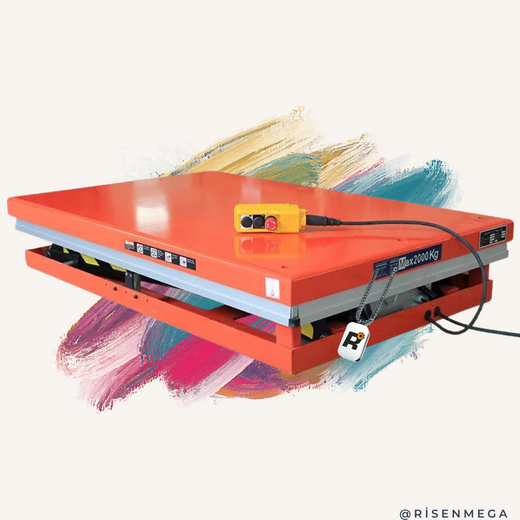
Standard Electric Scissor Lift Tables 0.5-4Ton
General-purpose stationary lifting for lines, docks and workshops.
View specs →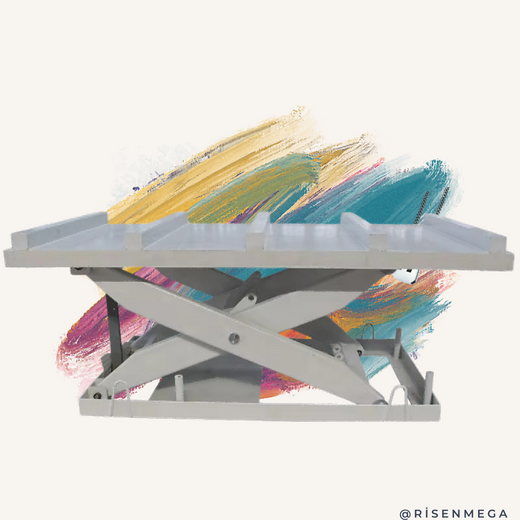
Heavy Duty Electric Scissor Lift Tables 2-4Ton
Reinforced tables for dense, heavy loads and long duty cycles.
View specs →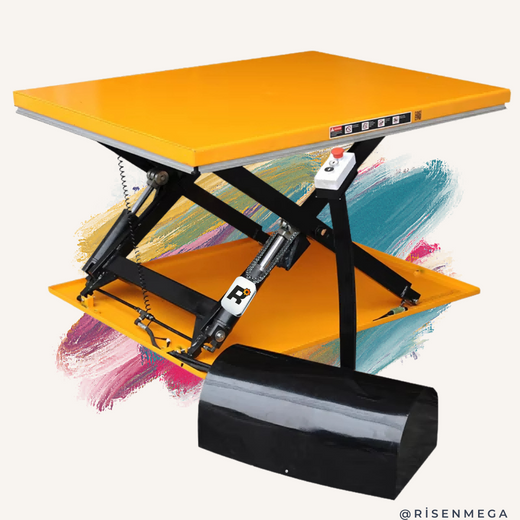
Low Height Scissor Lift Tables 0.5-2Ton
Low lowered height for easy pallet-truck loading from the floor.
View specs →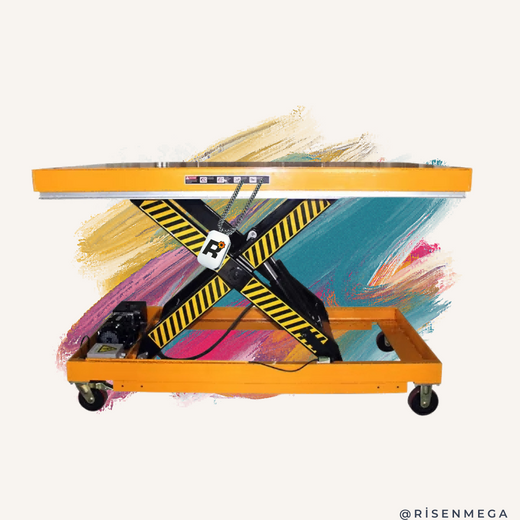
Movable Electric Scissor Lift Tables 0.5-2Ton
Wheeled lift table you can move between stations.
View specs →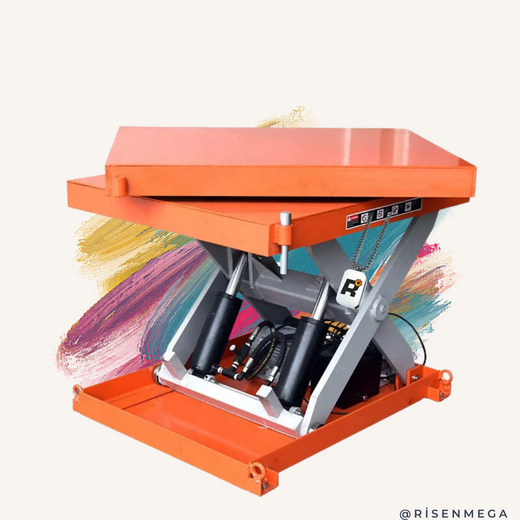
Rotary Scissor Lift Tables 0.5-4Ton
Turntable top for positioning and assembly without walking round the load.
View specs →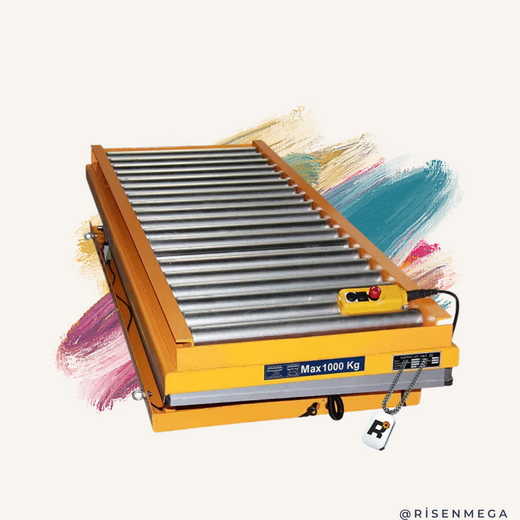
Rollers Scissor Lift Tables 0.5-4Ton
Roller platform for pushing loads on and off, or linking to conveyors.
View specs →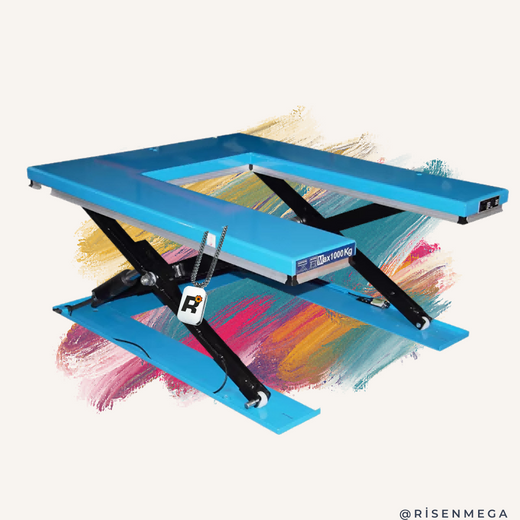
U Shape Scissor Lift Tables 0.5-4Ton
U-shaped platform designed for pallet and skid loading.
View specs →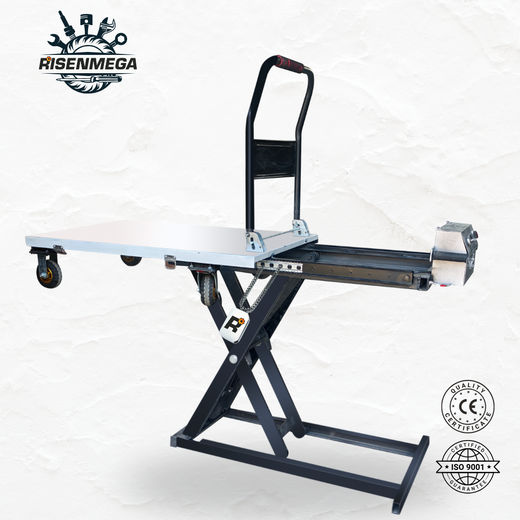
Electric Trolley 500KG Heavy Duty With Wheels
Compact powered trolley for lighter, mobile lifting jobs.
View specs →Lift table buying FAQ
What is a scissor lift table used for?
A scissor lift table raises and lowers loads to a working height. Typical jobs include feeding assembly lines, loading and unloading pallets, positioning goods at a dock or conveyor, and lifting heavy items to a comfortable working level so operators do not have to bend or overreach.
How do I choose the right capacity for a lift table?
Weigh the heaviest load you will ever place on the table, then add the pallet, container and any fixtures. As a practical rule of thumb, choose a capacity at least 20-25% above that total to allow for off-centre loads and shocks. Risenmega lists capacities of 300, 500, 1,000, 1,500, 2,000, 2,500, 3,000, 3,500 and 4,000 kg, and larger or custom capacities can be quoted.
What platform size do I need for a standard pallet?
The platform should be at least as large as the load footprint. For a 1,200 × 1,000 mm pallet, a 1,700 × 1,000 mm platform (such as the RMSSL1004 for 1,000 kg) holds the pallet with room to spare, and a 2,000 × 1,000 mm platform gives extra support for overhanging goods.
How low can a Risenmega lift table go?
In the standard RMSSL series the lowered platform height is 205-350 mm, depending on capacity and model. If your operators load from the floor with a pallet truck, ask for a low height lift table, or plan a small ramp or a floor pit.
Can a lift table be mobile?
Yes. Risenmega offers movable lift tables in manual and electric versions, and you can add heavy-duty casters to turn a stationary table into a mobile lift cart. For lighter work there are 300 kg and 500 kg electric trolley models with wheels.
How long does a lift table take to rise?
Across the standard RMSSL reference models, lifting time runs from about 20 to 40 seconds for a full stroke, depending on capacity, height and motor size (1.1, 1.5 or 2.2 kW).
Can Risenmega customize voltage, size and capacity?
Yes. Lifting height, load capacity, platform size, voltage, colour, hydraulic cylinder and other components can be customized. Options include wheels, a rotating turntable top, roller platforms, guardrails, bellows covers and fork attachments.
How much does a Risenmega lift table cost, and how do I order?
Listed starting prices run from $300 for 300-500 kg tables, $350 for 1,000-1,500 kg, $400 for 2,000-2,500 kg, $450 for 3,000-3,500 kg and $500 for 4,000 kg. Final quotations depend on platform size, height, voltage and options. After the model is confirmed, a 30% deposit starts production, and goods ship from Qingdao port under FOB, CIF or DDP terms.
Not sure which lift table fits? We will check for you.
Send Risenmega your load, pallet size, target height and voltage. Our team will confirm the model and quote before you commit budget.
Please include:
- Heaviest load and pallet or container size
- Pick-up height and delivery height
- How the load arrives (pallet truck, crane, by hand)
- Local voltage, phase and indoor/outdoor use
- Options needed: wheels, turntable, rollers, guardrails, bellows


